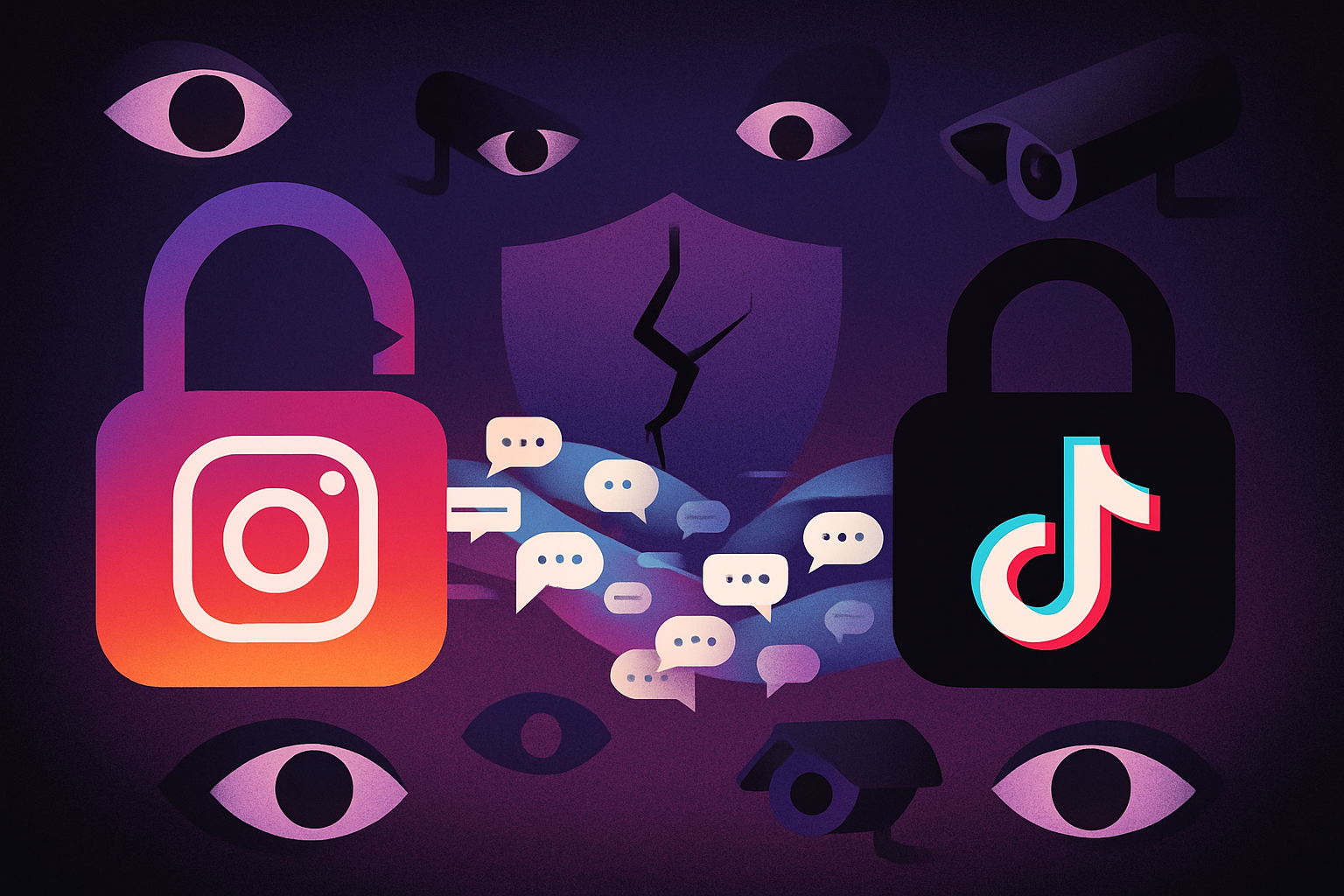
In the space of two weeks, two of the world’s largest social media platforms made decisions that collectively affect over three billion users — and both decisions went the same direction: away from encryption.
On March 4, TikTok told the BBC it will not introduce end-to-end encryption for direct messages, arguing the technology would make users “less safe.” Ten days later, Meta announced it will remove the end-to-end encryption option from Instagram DMs entirely, effective May 8, 2026.
Meta’s stated reason: “Very few people were opting in.” TikTok’s stated reason: child safety.
The real reason, for both, is simpler: the political and legal pressure to keep user messages accessible to platforms and law enforcement has become greater than the pressure to protect them. And what happens next will shape the future of private communication for everyone.
What Meta Is Actually Doing
Let’s be precise about what’s changing. Meta first began testing end-to-end encryption for Instagram DMs in 2021, as part of Mark Zuckerberg’s “privacy-focused vision for social networking”. The feature was never enabled by default — users had to actively opt in — and it was only available in certain regions.
After May 8, 2026, the feature will be removed entirely. Instagram DMs will no longer have any end-to-end encryption option. Messages will be encrypted in transit (meaning they can’t be intercepted between your device and Meta’s servers), but Meta will have the technical ability to access message content on its servers.
Users who have encrypted conversations will receive instructions for downloading their messages before the deadline. After that, the conversations will either be deleted or converted to standard (non-E2EE) messages.
Meta’s spokesperson directed users who want encrypted messaging to WhatsApp — which, notably, has end-to-end encryption enabled by default and has maintained it despite similar pressure. Messenger also retains E2EE, which Meta rolled out as default in December 2023.
The inconsistency is telling. Meta isn’t abandoning encryption as a principle — it’s abandoning it on the platform where the child safety arguments are most politically potent.
What TikTok Is Confirming
TikTok’s announcement is slightly different in form but identical in effect. The platform has never offered end-to-end encryption for DMs. What changed is that TikTok explicitly confirmed this is a deliberate policy decision, not a feature they haven’t gotten around to building yet.
TikTok told the BBC that end-to-end encryption would prevent its safety teams and law enforcement from viewing material sent in direct messages, potentially enabling child exploitation and other harmful content to spread undetected. A TikTok USDS spokesperson told PCMag that DMs are “encrypted in transit and at rest” — meaning the data is protected from external interception and stored securely — but TikTok retains the ability to access message content.
The distinction matters: encryption in transit and at rest protects against hackers. End-to-end encryption protects against the platform itself. TikTok is offering the first while explicitly rejecting the second.
The “Nobody Used It” Defense
Meta’s claim that “very few people” used Instagram’s E2EE option deserves scrutiny.
The feature was:
- Not enabled by default — users had to actively find and enable it
- Only available in some regions — not globally accessible
- Poorly promoted — Meta invested minimal effort in user education about the feature
- Buried in settings — not surfaced during normal messaging flows
If you design a feature to be invisible, don’t promote it, restrict its availability, and then kill it because nobody used it, you haven’t learned that people don’t want encryption. You’ve learned that people don’t use features they don’t know exist.
Compare this to WhatsApp, where E2EE is the default and cannot be turned off. WhatsApp has over two billion users, all of whom use end-to-end encryption for every message, because they don’t have to choose to. The lesson isn’t that users don’t want encryption — it’s that defaults determine adoption.
Meta’s decision to make Instagram E2EE opt-in rather than default was, in retrospect, likely strategic. Low adoption provides the political cover to remove the feature when pressure mounts.
The Child Safety Argument
Both Meta and TikTok frame their decisions around child safety. And the child safety concerns around encrypted messaging are real — this isn’t manufactured.
The National Center for Missing & Exploited Children (NCMEC) has consistently argued that end-to-end encryption hampers the detection of child sexual abuse material (CSAM). In 2024, Meta’s own platforms generated the majority of CSAM reports to NCMEC — reports that are possible because Meta can scan unencrypted messages for known CSAM imagery.
When Messenger enabled default E2EE in late 2023, child safety organizations warned that CSAM detection rates would plummet. Reuters reported in February 2026 that Meta’s own internal warnings in 2019 flagged that encryption would hinder the company’s ability to detect illegal activities.
The UK’s Online Safety Act, Australia’s Online Safety Act, and the EU’s proposed “Chat Control” regulation all either require or contemplate requiring platforms to detect CSAM in messages — something that’s technically impossible with true end-to-end encryption unless you introduce client-side scanning (which privacy advocates argue is a backdoor by another name).
The child safety argument is the most politically effective challenge to encryption because it’s the hardest to argue against publicly. Nobody wants to be on the side of “protecting child predators.” This makes it the perfect lever for governments and advocacy groups pushing for broader surveillance capabilities.
But the child safety framing obscures a critical fact: removing encryption doesn’t just expose predators’ messages. It exposes everyone’s messages — including those of the children the policy claims to protect.
What This Means for Your Privacy
Instagram users: your DMs become readable
After May 8, every Instagram DM you send can technically be accessed by Meta. This means:
- Meta can scan message content for advertising targeting, content moderation, and compliance with law enforcement requests
- Law enforcement can compel disclosure of Instagram DM content through warrants and subpoenas
- A data breach could expose message content — encrypted-at-rest protections are good but not equivalent to E2EE, where even the platform can’t decrypt messages
- Meta’s AI systems can process your conversations for training data, content recommendations, or behavioral analysis
If you’ve been using Instagram’s encrypted DMs for sensitive conversations, you need to migrate those conversations to an E2EE platform before May 8. WhatsApp maintains default E2EE, as does Signal.
TikTok users: your DMs were never private
If you assumed TikTok DMs were encrypted end-to-end, they weren’t. They never were. Every message you’ve ever sent on TikTok has been accessible to the platform — and, through legal process, to law enforcement.
For users communicating with minors, this may be seen as a safety feature. For everyone else — political dissidents, journalists, activists, people in authoritarian countries — it’s a surveillance exposure.
This is particularly concerning given TikTok’s ownership by ByteDance and the ongoing geopolitical concerns about Chinese government access to TikTok user data. DMs without E2EE are accessible to the platform operator, and whatever government has leverage over that operator.
The precedent for other platforms
The most dangerous implication isn’t about Instagram or TikTok specifically. It’s about the signal these decisions send to every other platform considering encryption:
The political calculation has changed. Two years ago, Meta was expanding E2EE across its platforms. Now it’s contracting. The message to other companies is clear: implementing E2EE will generate sustained political backlash, and removing it will generate brief privacy criticism that fades quickly.
“Nobody used it” is now a playbook. Make encryption opt-in. Don’t promote it. Wait for low adoption. Remove it, citing low usage. Other platforms facing E2EE pressure now have a template.
Child safety trumps privacy in legislative priority. Every major legislative push against encryption — the UK’s Online Safety Act, the EU’s Chat Control proposal, Australia’s regulations — uses child safety as the primary justification. These decisions suggest that tech companies have concluded the political fight is unwinnable.
Where Encryption Still Lives
Despite the retreat, end-to-end encryption remains available on several major platforms:
| Platform | E2EE Status | Default? | Notes |
|---|---|---|---|
| Signal | Full E2EE | Yes | Gold standard. Open-source protocol. Under attack from Russian cyber operations |
| Full E2EE | Yes | Uses Signal protocol. Privacy guide here. Note: metadata not encrypted | |
| Messenger | Full E2EE | Yes (since Dec 2023) | Meta maintains E2EE here despite removing from Instagram |
| iMessage | Full E2EE | Yes | Apple-to-Apple only. Falls back to SMS for non-Apple |
| Telegram | E2EE available | No | Only in “Secret Chats.” Regular chats are NOT E2EE |
| Being removed | Never was default | Dead after May 8, 2026 | |
| TikTok | No E2EE | N/A | Explicitly refused to implement |
What to do right now
-
Audit your messaging habits. Which platforms do you use for sensitive conversations? If the answer includes Instagram or TikTok, migrate those conversations.
-
Default to Signal for sensitive communications. It’s free, open-source, and maintains the strongest encryption implementation available. Yes, it’s being targeted by state actors — that tells you it works.
-
Enable disappearing messages. On platforms that support them (Signal, WhatsApp), enable automatic message deletion. Even with E2EE, messages on a seized device are readable.
-
Download your Instagram encrypted chats. Before May 8, export any conversations you want to preserve from Instagram’s E2EE mode.
-
Review your Instagram privacy settings. With E2EE gone, minimize what you share through DMs. Treat Instagram messages as postcards, not sealed letters.
-
Don’t assume any social media DM is private. This is the broader lesson. Platforms can change encryption policies at any time. If a conversation truly needs to be private, have it on a platform where encryption is the core product (Signal), not an optional feature that can be revoked.
The Uncomfortable Truth
Here’s what both Meta and TikTok won’t say directly: end-to-end encryption is bad for their business models.
Meta’s advertising empire runs on understanding user behavior, preferences, and relationships. Encrypted messages are a black box that Meta can’t mine for advertising signals. TikTok’s recommendation algorithm benefits from understanding what users discuss and share. Encryption limits that understanding.
Child safety is a real concern. But it’s also a convenient one — because it aligns the interests of governments (who want surveillance access), platforms (who want data access), and child protection organizations (who want content detection) against the single opposing interest: user privacy.
The question isn’t whether child safety matters. It does. The question is whether dismantling encryption — a technology that protects billions of people’s private communications from hackers, stalkers, authoritarian governments, and corporate surveillance — is the right way to address it.
Meta’s own history of privacy controversies, data breaches, and enabling child exploitation on its platforms despite having full access to unencrypted content suggests that the ability to read messages isn’t, by itself, a solution.
The encryption retreat is real. The question now is whether it stops at Instagram and TikTok — or whether it’s the beginning of a broader rollback that eventually reaches WhatsApp, Messenger, and the platforms where encryption is still default.
If you care about private communication, the time to choose your platforms deliberately is now. Not after the next announcement.
For platform-specific privacy guides, see our coverage of WhatsApp privacy controls, Instagram privacy settings, Facebook security essentials, and Meta AI’s privacy implications. For the state-level threat to encrypted messaging, see Russian cyber warfare targeting Signal.